

Michael Carrick’s style of play shows he has learnt lessons from Rúben Amorim’s stint in charge of Manchester United.
When Michael Carrick was announced as Manchester United’s head coach until the end of the season – notice he’s not officially an interim – fans were excited about the prospect of a return to a back-four, following just over a year of Rúben Amorim’s unpopular back-three style, although perhaps that wouldn’t have been as unpopular if more points were won.
But this wasn’t the first taste of Carrick-ball at Old Trafford. United’s former No.16 took interim charge of the club when Ole Gunnar Solskjær was sacked in 2021. Like Darren Fletcher this time round, Carrick was given the caretaker job while United searched for a longer-term interim.
Ralf Rangnick attempted to establish a high-pressing 4-2-2-2 style, with Edinson Cavani and Cristiano Ronaldo partnering each other in the frontline. On paper, brilliant idea. In reality, not so much. United picked up just 58 points that season, meaning a sixth-place finish in the Premier League and a Europa League campaign for Erik ten Hag next season.
Unlike Rangnick, Carrick has established his own style of football. It features many features from his stint in charge of Middlesbrough, in which he took the club from the relegation zone to the Championship playoffs in the same season – 21st place to fourth place, to be exact. He also guided Boro to a Carabao Cup semi-final; they won the first leg 1-0, but lost 6-1 at Stamford Bridge in the second leg.
Going back to the present day, Carrick has already led United to impressive wins against Manchester City, Arsenal and Tottenham Hotspur, not to mention a last-minute winner against Fulham and a late equaliser against West Ham United. But how? UtdDistrict took a look.
Carrick takes key lessons from Amorim
Under Rúben Amorim, United were often left exposed in central midfield, as they were under Erik ten Hag, to be fair. But rather than attempting to tweak his 3-4-2-1 shape to counteract United’s lag of legs in midfield, Amorim stuck to his guns and even benched Kobbie Mainoo – one of the most tactically intelligent players in the United squad. Smart move.
Amorim wanted his side to press high, but when they did, United often left huge gaps in the centre of midfield. For some games, Amorim found a solution to this issue, with the wide centre-backs pushing into central midfield and following their man. Against Chelsea, it worked wonders, but that created another problem: gaps in central defence.
Michael Carrick, though, has immediately understood how he needs to set up his Manchester United side without the ball, so the same issues aren’t present.
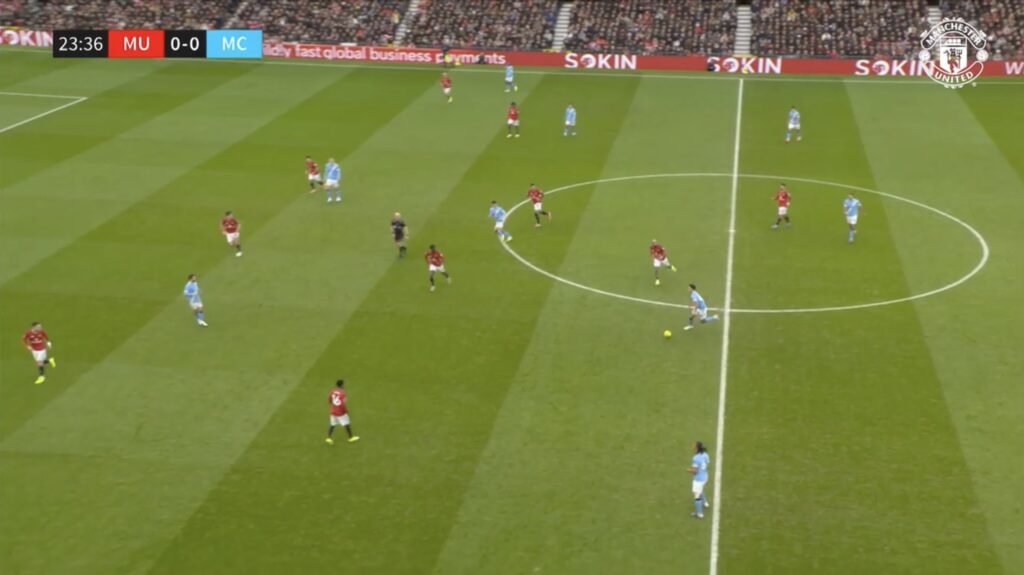
As he did at Middlesbrough, Carrick likes to deploy a 4-4-2 midblock out-of-possession. The attacking midfielder, Bruno Fernandes, joins Bryan Mbeumo to form a front two, with the rest of the midfielders forming a flat four shape in front of the defensive four. They then move across the pitch, pushing the ball out wide, before attempting to suffocate the flank and either force the opposition into a mistake or at least backwards.
In this example, City can’t find the pass to Bernardo Silva, as Mainoo moves over and Amad tucks inside. This forces them backwards and over to the left flank to attempt a similar pattern, again.
United’s defensive solidity also sets them up well for the counterattack. If Mainoo intercepted the forward pass in this example, he would be able to play it forward to Amad or Mbeumo, who would have just two or one defenders to beat, respectively, before being in one-on-one against the goalkeeper. Believe it or not, the Old Trafford crowd quite likes this.
Carrick is one of the few coaches in recent years to understand how to set United up without the ball in a way that doesn’t frustrate the United faithful with a tepid and slow approach (think Jose Mourinho or Louis van Gaal), but also doesn’t leave them wide open in midfield (Amorim and Ten Hag).
United’s in-possession fluidity
Under Ole Gunnar Solskjær, United were known for their fluid front three. Mason Greenwood, Anthony Martial and Marcus Rashford were given the freedom to rotate with each other as they saw fit. It was then a case of “Who am I supposed to mark?” for the opposition. And the same can be said for Carrick’s United side, with Amad, Matheus Cunha and Bryan Mbeumo.
When Patrick Dorgu started on the left flank, United’s attack appeared slightly more structured, but that merely invited Bruno Fernandes to rotate with the centre-forward and right-winger, as is the case when Benjamin Šeško finds himself on the pitch. Fernandes then looks to move outwide, with the wide players moving inside to the vacant space.
Unlike under Solskjær, the fluidity isn’t confined to the attack. Kobbie Mainoo often finds himself on the left flank, before somehow appearing on the right wing just minutes later. Carrick has allowed Mainoo to roam with the ball, allowing his creativity to flourish, as was proven for Dorgu’s goal against Arsenal
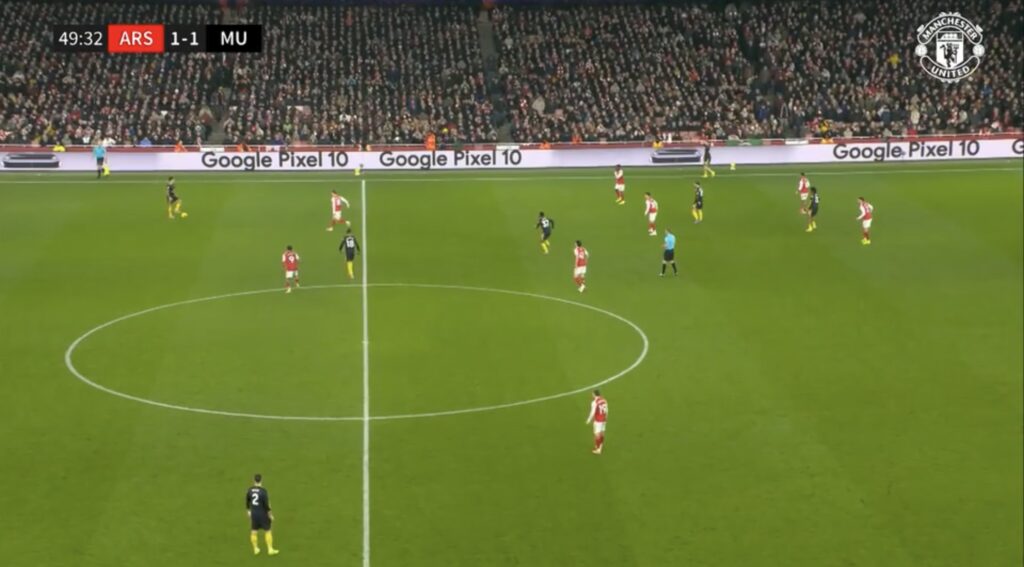
Just seconds before Dorgu’s wonderstrike, Mainoo moves over to the left side, offering a passing option for Lisandro Martínez. With no clear way through, Martínez plays it right to Harry Maguire, who takes it upon himself to drive United forward with a progressive run.
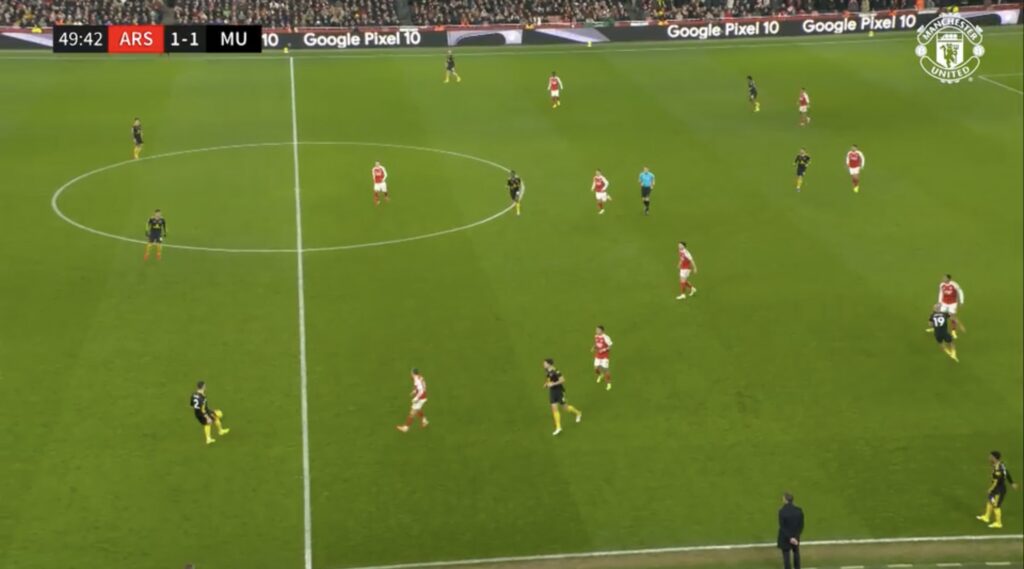
Casemiro recognises the now gaping hole in the middle of United’s defence, and Mainoo moves over to act as the single pivot. To give credit where it’s due, Mainoo likely would’ve struggled to cover ground as he does now without Amorim’s coaching. Notice Fernandes has also moved to the centre-forward position, as United were looking to overload the right-hand side with Amad and Mbeumo.
For Dorgu’s goal, just seconds later, Fernandes drops deeper, allowing Mbeumo to return to his natural position, and Dorgu comes inside. The young Dane combines with his captain to find himself in space just outside the box and, wow. There was no stopping that. But, not to take away from Dorgu’s finish, it wouldn’t have happened without the freedom of movement in midfield and attack. If Dorgu earned a big hug for the goal, I think Carrick at least deserves a firm handshake.
What happens when United dominate the ball?
Now, in-possession tactics are vastly different depending on the opposition you face. If you’re coming up against a Manchester City, for example, you can instruct your players to move the ball forward with pace every time you get the ball. Against West Ham United? Not so much.
To say United struggled against West Ham would be incorrect. They dominated the game and only really conceded chances after Diogo Dalot’s substitution, when United switched to a back three to get something from the game. West Ham’s goal, though, was a poor moment for Luke Shaw and an unfortunate error that put United on the back foot early on.
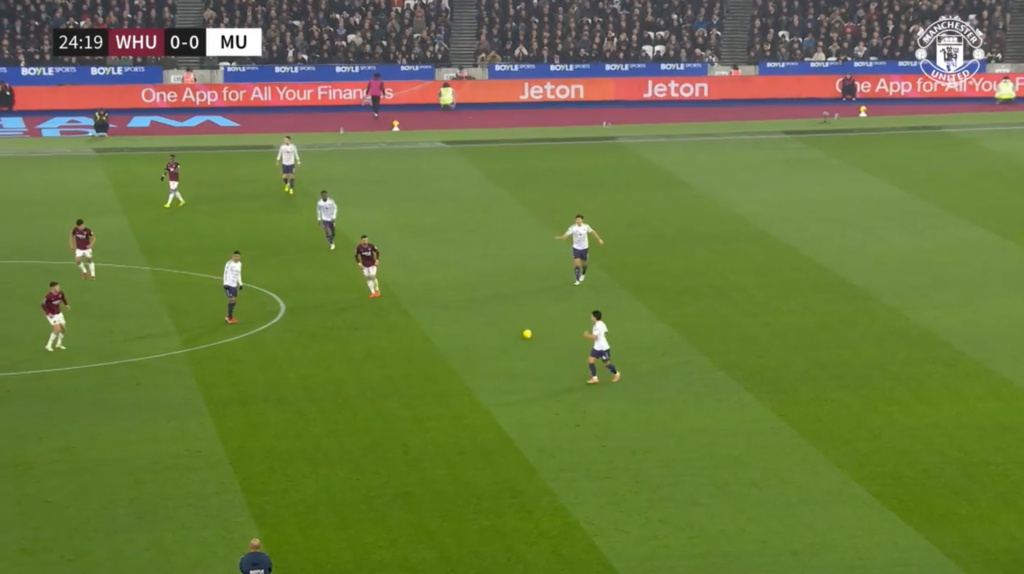
Thinking more about what went well in that game, United had a solid structure when building from the back. Shaw pushed forward into the front line, and Diogo Dalot inverted into central defence, with Maguire moving central. Casemiro and Mainoo sat just ahead to create a 3-2 shape. Sound familiar? It’s the same structure Amorim liked to use, but it worked much better.
Under Amorim, United struggled to break down a low block, with difficulty moving the ball into the final third. Carrick struggled to break down a low block, but 33% of the game was played in West Ham’s defensive third, according to SofaScore. The issue was the lack of a presence in the box.
When Joshua Zirkzee and Šeško came on, United created their best two chances through crosses into the box. Zirkzee narrowly missed with a header, and Šeško scored a late equaliser to earn United a point.
Like all managers at some point in their career, Carrick was afraid to change a winning team, but Šeško must start against Everton, when United will face another low-block side.
Can Carrick continue the good run of form?
A new manager bounce isn’t a term for no reason. Most new managers – or head coaches, in Carrick’s case – experience a run of good form when they take up a new position, as they have new ideas and the opposition don’t know how to deal with them. However, there comes a point when that form stops, and a bad patch arrives.
The difference with Carrick is that, for now, he knows when his tenure will come to a close. It’s not impossible that he is awarded the full-time role for next season and beyond, but that won’t be his expectation. So, does that good form have to end?
Short answer – no. Carrick has spoken about his willingness to make tactical changes where necessary. Before the trip to Arsenal, he said: “I think it gives us the foundation to build on, it won’t be the same and it’ll look a bit different, we’ve got some different ideas and tweaks that we are trying to put into the game.”
Deciding if Carrick is the right man to lead United forward is not an easy decision for Omar Berrada and Jason Wilcox, but if Carrick can show he can adapt to opponents, while maintaining some principles, he’s doing everything he can to put his name at the top of the list.
Either way, he’s already learnt lessons Amorim didn’t in over a year in charge.
Make sure to follow UtdDistrict on X, Instagram, Facebook, YouTube, and TikTok to never miss out on any of our Manchester United content. Our podcast, What the Devil?, is streamed live every Thursday at 14:00 pm (GMT) on the United View YouTube channel.